
I’m sure that someone at some point will have called it the bible of advertising strategy, the “J Walter Thompson Planning Guide (March 1974),” by Stephen King* has, in time, proven to be ground-breaking despite the low-key title (giving it very poor marketability, which is ironic. I think he underestimated it’s impact and didn’t expect for it to leak outside of JWT). It seems to exist only as a photocopy which adds to the magic and I like to imagine that there’s only one original copy, securely protected in JWT vaults. I’m not Googling it because I don’t want to learn it’s available in the bargain bin of my local bookshop, ruining the mystique forever.
Anyway, I digress. The JWT Planning Guide is still a relevant point of reference despite being written back when things were still in black-and-white and the industry was much like season seven of “Mad Men”. But with accelerating technological advances, is it still relevant? It sounds like a cliché, but I will say it anyway: It’s more relevant than ever.**
The full guide needs to be read. It is worth the 30 minutes it takes (plus subsequent hours to fully digest) and worth returning to once in a while, especially as it’s written on a typewriter, which gives it a reassuring and aesthetically-pleasing gravitas. There is little point in trying to summarize such a concise and well-written document for the sake of a blog post so instead, here are some of the points I ponder on from the earlier section which cover advertising’s contribution to marketing:
‘Advertising is not the communication but the response to the communication.’
What is the point of creating adverts if they do not change anyone’s behaviors?
‘Brands are like people’
People are complex. Brands are complex. Our view of people is created from a blend of their attributes. The same is true for brands. They can hit all the senses. They can fulfill needs/reasons. They can evoke emotion.
‘Any successful brand has a blend of motivating and discriminating appeals’
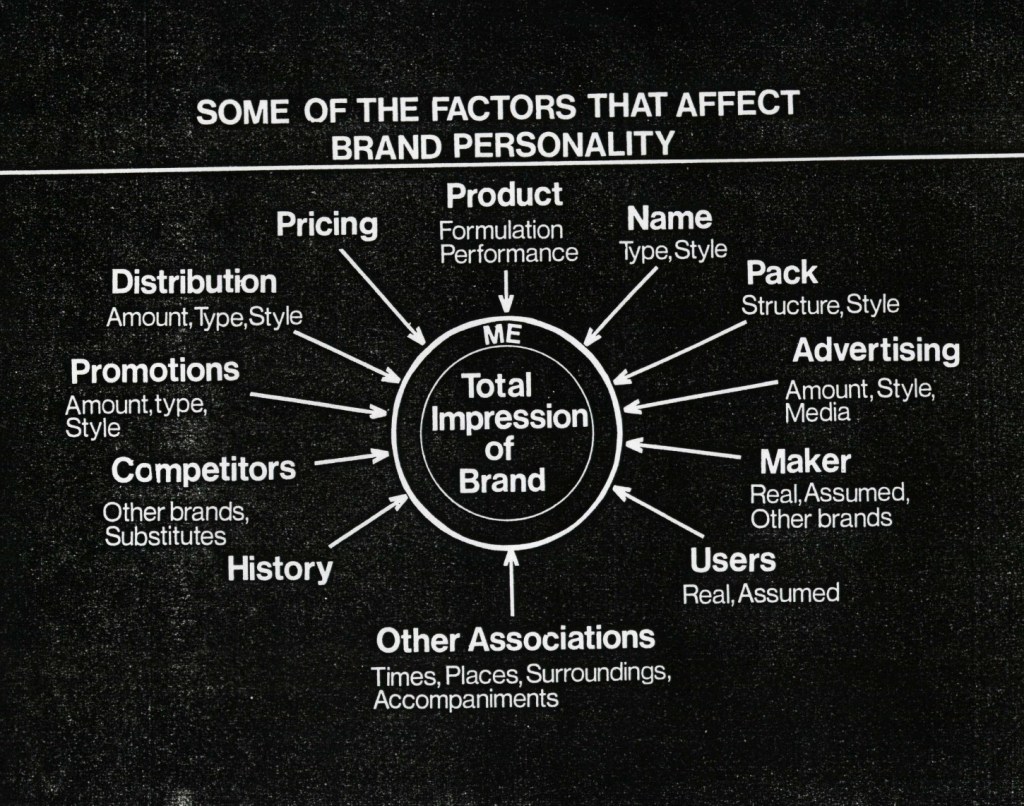
‘If advertising is to be fully effective, it must contribute both directly and indirectly’
Where ‘ direct’ means to remind people of the product’s existence, and how it can fulfill a current want/need, and ‘indirect’ means the long-term building of opinions of the brand often by adding non-functional values. I would say that since this guide was written, advertisers have taken this to the extreme where the indirect contribution is the focus and these days you very rarely hear about products being the tastiest, most effective, most efficient, best at what it does…
‘Communication should not be thought of as the sending and receiving of a message; it is more the sending of a stimulus’
Among several sub-points, one is a reminder that response to an advert may not be as expected, and therefore the response is what matters, not the advert (stimulus).
The later sections of the guide are more about implementation, are more practical and go into much more depth so definitely needs reading. Based around five key questions, the guide suggests this is a loop of questions to continually ask to continually inform your strategy:
Where are we?
Why are we there?
Where could we be?
How could we get there?
Are we getting there? (then go back to ‘Where are we?’ and continue this loop FOREVER….)
I’m not sure why I went to that effort in picking bits out – just read it!
As I see it, the only down-side is that perhaps it shows it’s age in that it sounds like common sense now, as the learning points have become ingrained in the industry over the last half-century. Still, even for those familiar with it, it’s worth a re-read once in a while and its 50th anniversary seems as good a time as any.
I’m going to have another read of it now. It is past midday so I might drink a neat bourbon as I do so, in honor of the trailblazing ad men and women of 1974.
Edit: Too much bourbon. Forgot to share a link to the document. Here’s one: https://plannersphere.pbworks.com/f/JWTPlanningGuide.pdf
* No, not that Stephen King. Well, I don’t think it’s that Stephen King. Either way – I’m still waiting for this book to be turned into a movie. The obvious choice would be to find a suave British version of Jon Hamm to play King – though I’d be tempted to go with Jason Statham for maximum marketability! (It’s what Stephen King would have wanted.)
** Probably not true. In my defense, my response is likely just a symptom of the times we live in where everything needs to be controversial to drive digital attention. It’s not me, it’s society’s fault!
 GPH in NYC: Proposals, Grants, Editing, Writing, Project Management...
Leave a comment